
Disclosure: This article may contain affiliate links. If you purchase through these links, Elionyx may earn a commission at no additional cost to you. As an Amazon Associate, we earn from qualifying purchases. Thank you for supporting our work.
Disclaimer: This article is for educational purposes only and should not be considered financial, legal, tax, or investment advice. Financial decisions depend on your personal circumstances. If you’re unsure which strategy is right for you, consider speaking with a qualified financial professional.
It was October 14th when Priya’s boiler stopped working. Not a slow decline — just a Tuesday morning, cold radiators, and a plumber’s voicemail. The repair bill came to $1,140. She had $200 in her savings account and a credit card she had spent six months trying to pay down. That $1,140 didn’t just break her boiler budget. It broke her entire financial plan for the next four months.
The worst part? She knew the boiler was old. She’d thought about it in passing the previous winter. She just never did anything about it.
That’s the story most of us are living — not because we’re careless, but because nobody ever taught us how to plan for the things we already know are coming. We save for emergencies (or try to). We budget for monthly bills. But the whole middle category — the big, predictable, irregular expenses that don’t fit neatly into either box — gets ignored until it becomes a crisis.
That middle category has a name. It’s called a sinking fund. And it might be the single most practical financial tool most people have never heard of.
What Exactly Is a Sinking Fund?
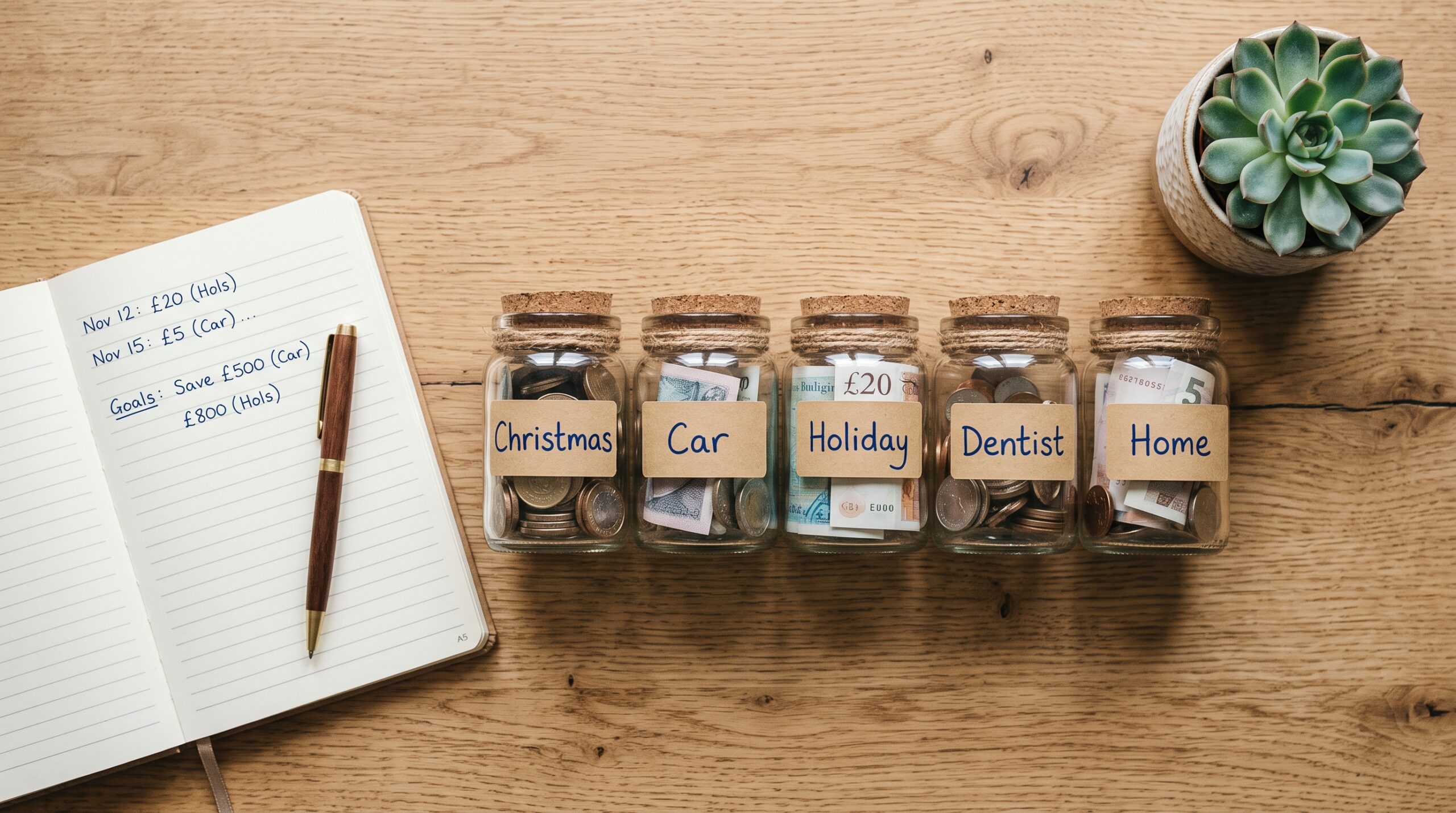
A sinking fund is money you set aside gradually, over time, for a specific expense you know is coming — but that doesn’t happen every month.
That’s it. That’s the whole concept.
You identify an upcoming expense. You calculate how much it will cost. You decide when you’ll need the money. You divide the total by the number of months until then. You save that amount every month until the money is there, ready and waiting, when the bill arrives.
No scrambling. No credit card. No borrowing from other budget categories. No financial hangover.
The name sounds technical — and in corporate finance, sinking funds are used by companies to gradually set aside money to repay bonds and debt. But for personal finance, the principle is exactly the same, just applied to your real life: you sink money into a dedicated pot, little by little, so the big expense doesn’t sink you when it shows up.
Kumiko Love, an accredited financial counselor and founder of The Budget Mom, who used sinking funds to become completely debt-free and now helps over a million followers manage their money, describes it simply: “Sinking funds are there so we no longer have to rely on debt when the time comes.”
That sentence deserves a moment. Because for most people, the reason they go into debt for predictable expenses isn’t that they couldn’t have saved for them. It’s that they didn’t have a system for doing it. A sinking fund is that system.
How Is It Different From an Emergency Fund?
This is the question people ask most often, and the distinction is genuinely important — because mixing them up is one of the most common and costly budgeting mistakes.
An emergency fund is for the unexpected. The job loss. The medical bill that appears without warning. The car that breaks down the week after you just paid it off. These are things you cannot predict — you only know that something will eventually go wrong, so you keep money set aside for when it does.
A sinking fund is for the predictable. The annual car insurance renewal. The December Christmas spend. The family holiday you’ve been planning for six months. The dentist bill you know is coming because you’ve been putting off that crown for eight months. These are things you absolutely can see coming — you just haven’t been formally planning for them.
As Mary Kamelle, marketing manager at the nonprofit credit counseling agency American Consumer Credit Counseling, explains: keeping these funds separate “ensures you don’t accidentally use those funds for the wrong purpose and helps you stay consistent in your budget.”
Think of it this way:
- Emergency fund = your financial safety net (for things you can’t predict)
- Sinking fund = your financial planning tool (for things you can predict)
Both are essential. Neither replaces the other. And if you’ve been using your emergency fund for things you actually could have planned for — a holiday, a birthday party, school fees — you’ve been depleting your safety net for situations that weren’t really emergencies. Which means when a genuine emergency arrives, there’s nothing left.
The Expenses That Are Silently Wrecking Your Budget
Here is a question worth sitting with: how many of the following expenses genuinely surprised you in the last 12 months?
Most people, if they’re honest, will say almost none. They just didn’t have money set aside for them.
Annual and irregular expenses that most people never budget for:
- Car insurance renewal
- Home or renters insurance renewal
- Annual subscription renewals (Amazon Prime, antivirus software, cloud storage)
- Christmas and holiday gifts
- Back-to-school supplies and fees
- Car maintenance — tyres, oil changes, MOT or inspection
- Medical or dental co-pays and bills
- Property taxes (if not escrowed)
- HOA fees
- Family birthdays and celebrations
- School trips and activities
- Pet vet bills, grooming, and vaccinations
- Home repairs and maintenance
- Holidays and travel
- Clothing seasonal refresh
- Technology replacement (phone, laptop)
- Wedding or event attendance costs
Look at that list. These are not surprises. Every single one of them is predictable — either because they happen on a schedule, or because you can see them building on the horizon. Yet for most households, each one lands as a disruption. Something gets charged to a card. Something else gets delayed. The budget wobbles, recovers, and then wobbles again at the next one.
According to a NerdWallet survey, 35% of Americans say their holiday spending was financially irresponsible — taking on debt or overspending — and 31% of holiday shoppers who used credit cards to buy gifts still hadn’t paid off the balances nearly one year later. That’s not a discipline problem. That’s a planning problem. And sinking funds solve it.
A Real Example: The Christmas Fund That Changed Everything
Let me show you how this works in practice.
James and Nadia had the same argument every November. Money was tight heading into December — it always was — and they had to decide how much to spend on gifts for three kids, two sets of parents, a work gift exchange, Christmas dinner, and the various school events that somehow always coincided with the most expensive month of the year.
They would set a budget. Spend more than it. Put the rest on a card. Spend January and February trying to pay it off. Repeat the following year.
In January of one year, they tried something different. They sat down and estimated what a reasonable Christmas actually cost them: gifts ($600), food and hosting ($200), school events and contributions ($100), miscellaneous ($100). Total: $1,000.
They divided $1,000 by 11 months (January through November) and got $91. They opened a separate savings account — just for Christmas — and set up an automatic transfer of $91 on the first of every month.
By November, $1,001 was sitting in that account, untouched, waiting. December that year was the first December in years that didn’t feel like a financial emergency. They bought what they planned to buy. They hosted. They gave. They went into January with zero new credit card debt from the holidays.
“It sounds obvious when you explain it,” Nadia said. “But we’d just never thought to save for it in advance like that. We’d always just hoped there’d be enough.”
That’s the quiet power of a sinking fund. It turns hope into a plan.
How to Set Up a Sinking Fund: Step by Step
Setting up a sinking fund takes about 20 minutes the first time. After that, it runs itself.
Step 1: List Every Irregular Expense You Can Think Of
Go through the list above and add anything specific to your life. Think about the past 12 months and identify every expense that disrupted your budget. Write them all down with an estimated annual cost.
Don’t aim for perfection. An educated estimate is enough to start. You can refine the numbers as you go.
Step 2: Prioritise
If you try to fund everything at once on a limited income, you’ll spread yourself too thin and the system will feel overwhelming. Start with two or three funds that are either coming up soon or have caused the most pain historically. For most people that’s some combination of: car maintenance, Christmas, and one annual bill that always catches them off guard.
Step 3: Do the Simple Maths
For each fund:
Total cost ÷ Number of months until you need it = Monthly contribution
Examples:
| Expense | Total Cost | Months Away | Monthly Contribution |
|---|---|---|---|
| Christmas | $800 | 9 months | $89/month |
| Car insurance renewal | $960 | 12 months | $80/month |
| Annual dental | $400 | 8 months | $50/month |
| Family holiday | $2,400 | 18 months | $133/month |
| Car maintenance | $600 | Ongoing | $50/month |
These numbers are illustrative — yours will be different. But the maths is always the same.
Step 4: Open a Dedicated Account (or Use Savings Buckets)
The most important structural rule of a sinking fund is keeping it separate from your regular savings and separate from your emergency fund. When money is mixed together, it gets spent on the wrong things. What’s earmarked for Christmas disappears into a random Thursday because it was just sitting in your main account looking available.
Several banks now offer “buckets” or sub-savings accounts — separate labelled pots within one account — that make this easy. Ally Bank’s savings “buckets” feature, for instance, lets you create sinking funds for home repairs, car costs, holidays, and more, all under one account, so you can see exactly how much you’ve saved for each goal without doing any mental math.
If your bank doesn’t offer this feature, simply open additional savings accounts — most banks allow multiple — and name each one clearly. “CAR INSURANCE.” “CHRISTMAS.” “HOLIDAY 2026.” The label matters. When you see the name, you’re less likely to raid it for something unrelated.
Step 5: Automate the Contribution
Set up an automatic transfer on the day you get paid — or the day after, to make sure the funds have cleared. The contribution should move before you have a chance to spend it on something else.
Automation removes the single biggest threat to any savings habit: the moment when you look at your balance and decide you’ll start next month. Next month never comes. Automate it, and it happens whether you remembered or not.
Step 6: Spend Without Guilt When the Time Comes
This is the part people forget to give themselves permission to do.
When the expense arrives and the money is there — use it. That’s what it’s for. You saved it specifically for this moment. Spending it isn’t failure; it’s the system working exactly as designed.
If there’s money left over after the expense, leave it in the fund (you’ll probably need it sooner than you think), move it to another sinking fund, or add it to your emergency fund.
How Many Sinking Funds Should You Have?
As many as you need — but start with fewer than you think.
Kumiko Love, who is completely debt-free and has been using sinking funds for years, currently runs 13 of them. But she didn’t start with 13. She started with the expenses that were causing the most financial pain and built from there.
NerdWallet’s personal finance contributor Amanda Barroso runs sinking funds for emergencies, home repairs, school tuition, vacations, car costs, and holidays — all within one savings account using the bucket feature.
If you’re just starting out: two or three funds is enough. Get comfortable with the habit. Automate it. Watch the balances grow. Add more funds as your budget allows and as you identify new expenses that deserve their own pot.
The goal is not to have the most sophisticated system. The goal is to have a system that actually runs — quietly, consistently, without requiring willpower or attention — in the background of your financial life.
What Happens When You Don’t Have One
Let’s go back to Priya and the boiler.
That $1,140 repair bill — the one that derailed four months of her financial plan — would have required a sinking fund contribution of just $95 a month if she’d started saving 12 months earlier. Or $48 a month over two years. For a boiler she already knew was aging.
Instead it went on a credit card at 22% interest. She paid it off slowly over four months, paying an extra $90 or so in interest in the process. She started the new year more behind than she ended the old one.
The math on not having a sinking fund isn’t just the inconvenience of scrambling. It’s the compounding cost of debt — money you pay to borrow for expenses you could have paid cash for, if you’d had a plan.
A recent CNBC report found that 1 in 3 Americans expects a major irregular expense in any given year. Those aren’t surprises. They’re scheduled. The only variable is whether you have money waiting for them or not.
The Unexpected Sinking Funds Worth Considering
Beyond the obvious categories, here are some sinking funds that are easy to overlook but quietly valuable:
Pet fund. Nearly half of pet owners say unexpected pet expenses caused them financial concern in a recent year, and the lifetime cost of caring for a dog has increased by more than 11% in recent years. Vet bills, dental cleanings, grooming, medications — these add up fast and come without notice.
Technology replacement fund. Phones, laptops, and tablets don’t last forever. Saving $30 to $50 a month means replacing them doesn’t require a payment plan or a credit card.
Self-care and wellness fund. Therapy, dental check-ups, glasses, gym membership renewals — these are easy to skip when money is tight, but skipping them has real costs. A dedicated fund means you don’t have to choose between your teeth and your budget.
Home maintenance fund. Homeowners generally recommend saving 1–2% of your home’s value annually for maintenance and repairs. If that sounds like a lot, start smaller — even $75 to $100 a month creates a buffer against the small repairs that would otherwise go on a card.
Career and education fund. Courses, certifications, conference registrations, professional memberships — investing in yourself has a real cost that rarely makes it into a monthly budget.
The Mindset Behind the Money
There’s something that happens when you have sinking funds running that’s harder to quantify than the maths but arguably more valuable: you stop dreading things.
The Christmas season stops feeling like a financial ambush. Your car insurance renewal stops making your stomach drop. Your kid’s school trip stops becoming a quiet source of guilt. The dentist stops being something you put off because you’re not sure where the money will come from.
When the money is already there, the experience of spending it changes completely. You’re not reacting to a crisis. You’re executing a plan. That shift — from reactive to intentional — is the real gift of a sinking fund.
Ramsey Solutions puts it simply: “Saving strategically means fun purchases will actually be fun, and frustrating expenses won’t be a big deal.”
That’s the version of your financial life that sinking funds make possible. Not perfect — just prepared.
Start Today: Your First Sinking Fund in 10 Minutes
Pick one expense from the list earlier in this article. The one that caused the most pain last time it came due. The one you know is coming again.
Calculate what it will cost. Divide by how many months until you need it. Open a savings account — or a savings bucket if your bank offers them — name it after the expense, and set up an automatic transfer for that monthly amount starting on your next payday.
That’s it. You’ve started.
The second fund will be easier. The third easier still. And the version of you twelve months from now — the one who opens a bill that used to cause anxiety and thinks, I’ve already got that covered — will be quietly grateful you did this today.
You don’t need the money yet. That’s precisely when to start saving it.
Have you tried sinking funds? Got a category that changed the way you manage money? Share it in the comments — the best personal finance advice usually comes from people who’ve actually lived it.
Related reads: