

Disclosure: This article may contain affiliate links. If you purchase through these links, Elionyx may earn a commission at no additional cost to you. As an Amazon Associate, we earn from qualifying purchases. Thank you for supporting our work.
Disclaimer: This article is intended for educational purposes only and should not be considered a substitute for professional medical advice, diagnosis, or treatment. If you have persistent fatigue or other concerning symptoms, consult a qualified healthcare professional.his article is for educational purposes only and is not medical advice. If you have severe, persistent, or worsening fatigue, seek evaluation from a qualified healthcare professional.
You slept eight hours last night. You know you did because you checked your phone at 11:47pm and again at 7:52am. Eight hours. And yet, here you are — sitting at your desk at 10 in the morning, reaching for your second coffee, wondering why your body feels like it’s been filled with wet sand.
You’re not lazy. You’re not being dramatic. And you are definitely not alone.
Fatigue has quietly become one of the most common complaints doctors hear — and one of the most dismissed. “You’re just stressed.” “Try sleeping earlier.” “Maybe exercise more.” You’ve heard them all. You’ve probably tried them all. And you’re still tired.
Here’s the thing nobody tells you upfront: being tired all the time is not always about sleep. In fact, for millions of people, the hours they spend in bed have almost nothing to do with why they can’t function during the day. The real reasons run deeper — and most of them are fixable, once you actually know what you’re dealing with.
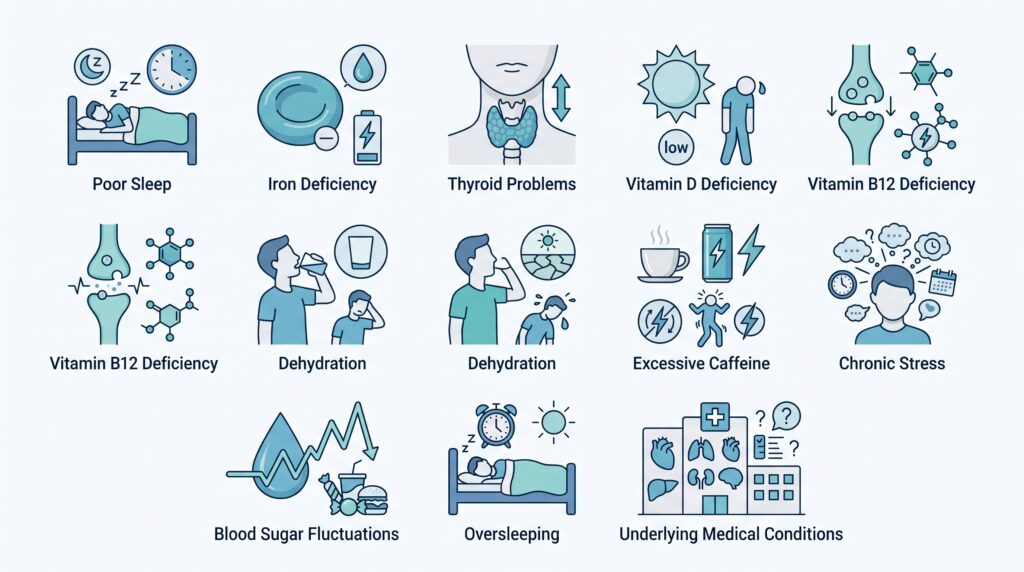
This article is going to walk you through 11 reasons why you might be exhausted despite doing everything “right” — including the ones that frequently get missed, dismissed, or misdiagnosed entirely. Some of them might surprise you.
First, Let’s Separate “Tired” From “Fatigued”
These two words get used interchangeably, but they’re not the same thing — and understanding the difference matters.
Tired is normal. You work a long day, you skip a night of good sleep, you spend a weekend moving furniture — you’re tired. Rest fixes it. You wake up the next morning feeling human again.
Fatigue is something else entirely. Dr. Jared Ankerman, a family medicine specialist at Cleveland Clinic, puts it plainly: “No matter how much you rest, or how little you do, you still have this feeling of not having a ton of energy or ability to do much.”
If you’re nodding at that description — if rest doesn’t actually restore you — what you’re experiencing is fatigue. And fatigue has causes. Real, identifiable, often treatable causes. Let’s find yours.
Reason 1: Your Sleep Is Broken, Not Short
This is the one that catches so many people off guard.
You think you slept eight hours. You were in bed for eight hours. But sleeping and actually sleeping are not the same thing. What matters isn’t just how long you were unconscious — it’s the quality of those hours.
During a normal night, your body moves through four to six sleep cycles. The deep, restorative sleep that actually repairs your brain and body — the kind that determines how you feel tomorrow — happens toward the end of each cycle. If something is interrupting those cycles, even briefly, you can spend eight hours in bed and wake up feeling like you barely slept at all.
Dr. Sonja Schuetz, a neurologist and sleep medicine specialist at the University of Michigan, calls this “unrefreshing sleep” — and she describes patients who say they feel like a truck ran over them every morning, regardless of how many hours they logged. “If sleep is chronically unrefreshing, you need a medical workup,” she says.
What breaks sleep cycles without you knowing? Sleep apnea is the big one “Cleveland Clinic’s sleep apnea information”. Your breathing stops — sometimes dozens of times per hour — your brain briefly jolts you to a lighter sleep stage to restart breathing, and you never reach the deep sleep your body needs. You don’t remember any of it. You just wake up exhausted, every single day, and have no idea why.
Sleep apnea affects an estimated 29 million Americans and is, according to Dr. Katelynn Sheaffer of Penn State Health, “very much underdiagnosed.” And it’s not just overweight middle-aged men. Women, younger adults, and people of all body sizes are being diagnosed in growing numbers.
What to do: If you snore, wake up with headaches, feel foggy in the morning no matter how long you slept, or your partner has ever nudged you because you stopped breathing — ask your doctor about a sleep study. Many can now be done at home.
Reason 2: Your Iron Is Low (And Nobody Checked)
Iron deficiency is the single most common nutritional deficiency in the world. It is also, according to multiple physicians, the most frequently overlooked cause of chronic fatigue in women.
Here’s what happens: iron is what your red blood cells use to carry oxygen around your body. When iron is low, your organs aren’t getting the oxygen they need to function. Your heart works harder. Your muscles tire faster. Your brain feels sluggish. You feel exhausted doing things that used to feel effortless.
The tricky part is that you can have low iron — even significantly low iron — without being technically anemic. Your haemoglobin might still look “normal” on standard bloodwork while your ferritin (stored iron) is depleted. Many doctors only check haemoglobin and miss this entirely.
Sandra, a 34-year-old teacher, spent nearly two years telling her doctor she was exhausted. She was sleeping well, eating reasonably, exercising three times a week. Standard bloodwork kept coming back “fine.” It wasn’t until she pushed for a full iron panel that her ferritin came back at 7 — when it should be at least 50 for optimal energy. She started iron supplementation and within six weeks described feeling “like a completely different person.”
Her story is not unusual. It’s remarkably common. Iron deficiency is the world’s most common nutritional deficiency.
What to do: Ask your doctor specifically to check your ferritin level — not just your haemoglobin. Eat iron-rich foods like spinach, lentils, red meat, and pumpkin seeds. If supplementing, take iron with vitamin C to improve absorption, and away from coffee or tea which block it.
Reason 3: Your Thyroid Is Underperforming
Your thyroid is a small butterfly-shaped gland in your neck, and it controls your metabolism — the speed at which your entire body runs. When it’s underactive (a condition called hypothyroidism), everything slows down. Your digestion slows. Your heart rate slows. Your thinking slows. And your energy drops to the floor.
The exhaustion from an underactive thyroid is a specific kind of tired. It’s heavy. It comes with brain fog, feeling cold when others don’t, dry skin, hair that falls out more than usual, and weight that creeps up despite no change in diet. Many people live with it for years, writing off every symptom individually, never connecting the dots.
Hypothyroidism is particularly common in women — affecting roughly 1 in 8 women at some point in their lives — and it frequently goes undiagnosed because the symptoms develop slowly and are easy to dismiss.
What makes it more complicated is the connection between thyroid function and nutrient levels. Research has shown that vitamin D and B12 deficiencies are significantly associated with autoimmune hypothyroidism “Mayo Clinic’s hypothyroidism overview.” The fatigue from B12 deficiency looks almost identical to thyroid fatigue — so when both are present, each one can mask or mimic the other, leading to years of chasing the wrong answer.
What to do: Ask for a thyroid function test that includes TSH, free T3, and free T4 — not just TSH alone. If autoimmune thyroid disease runs in your family, ask for an Anti-TPO antibody test too. Treatment for hypothyroidism, when properly diagnosed, is often straightforward and can dramatically restore energy levels.
Reason 4: Your Vitamin D Is Critically Low
If you live anywhere that isn’t sunny year-round — and even if you do — there is a reasonable chance your vitamin D is lower than it should be. Vitamin D deficiency is extraordinarily widespread, often called a silent epidemic, and fatigue is one of its primary symptoms “NIH Office of Dietary Supplements: Vitamin D Fact Sheet.”
What makes vitamin D unusual is that your body produces it through sun exposure on your skin. If you work indoors, live in a northern city, wear sunscreen (as you should), or have darker skin that requires longer sun exposure to produce the same amount, your levels can drop significantly — especially through winter months.
The fatigue that comes with low vitamin D is often accompanied by muscle weakness, low mood, and a general sense of heaviness that you can’t quite explain. People describe it as feeling like the world is slightly muted, like you’re operating at 70% without knowing what 100% even felt like.
What to do: Get a blood test specifically for 25-hydroxyvitamin D. If you’re deficient, your doctor will likely recommend a supplement. In the meantime, 15–30 minutes of midday sun on your arms and legs several times a week helps, though supplementation is often necessary during winter months regardless.
Reason 5: Your B12 Is Depleted
Vitamin B12 is essential for producing red blood cells and maintaining healthy nerve function. Without enough of it, your body simply cannot generate the energy it needs to get through the day.
B12 deficiency is particularly common in people who follow a vegan or vegetarian diet (since B12 is found almost exclusively in animal products), people over 50 (because the stomach’s ability to absorb B12 decreases with age), and people who take metformin for diabetes or long-term acid reflux medication — both of which interfere with B12 absorption.
The symptoms creep up slowly: fatigue first, then brain fog, then sometimes tingling in the hands and feet, irritability, or mood changes. Because it comes on gradually, many people have adapted to feeling this way and don’t even realize they’re not functioning at full capacity.
One thing worth knowing: B12 and thyroid issues frequently occur together, and their symptoms overlap almost completely. If you’ve been told your thyroid is fine but you still feel exhausted, ask specifically about B12. It often gets skipped on routine panels.
What to do: Ask for a B12 blood test. Foods rich in B12 include eggs, dairy, meat, fish, and shellfish. If you’re deficient or at risk, a daily B12 supplement or sublingual (under-the-tongue) B12 is highly effective and inexpensive.

Reason 6: You’re Dehydrated and Don’t Know It
This one sounds too simple to be true. It isn’t.
When you’re not drinking enough water, your blood becomes slightly thicker. Your heart has to work harder to pump it. Your organs have to work harder to function. The result is a low-grade, persistent fatigue that most people never connect to their water intake because they don’t feel particularly thirsty.
The problem is that thirst is a late signal. By the time you feel thirsty, you’re already mildly dehydrated. And mild dehydration — as little as 1–2% reduction in body water — has been shown to impair concentration, increase feelings of fatigue, and reduce physical performance.
Many people go through their entire day running on coffee, tea, and maybe one glass of water. Coffee and tea are mild diuretics — they make you lose more fluid. So the more you rely on caffeine to fight fatigue, the more dehydrated you may become, which makes the fatigue worse, which makes you reach for more coffee. It’s a quiet, invisible cycle.
What to do: Aim for 6 to 8 glasses of water throughout the day. If plain water bores you, add a slice of lemon, cucumber, or mint. A practical rule: your urine should be pale yellow. Dark yellow means you need more water.
Reason 7: Your Caffeine Is Working Against You
Speaking of coffee — let’s talk about it honestly.
Caffeine works by blocking adenosine, a chemical your brain produces that makes you feel sleepy. When you drink coffee, you temporarily stop feeling the tiredness that was already there. The adenosine doesn’t go away — it accumulates. When the caffeine wears off, all that adenosine floods back at once, and you crash harder than you would have without the coffee.
This is the cycle most tired people are living in: coffee to function in the morning, crash by early afternoon, another coffee to recover, difficulty sleeping at night, less restorative sleep, wake up exhausted, repeat.
The second issue is timing. Caffeine has a half-life of roughly five to six hours. A coffee at 3pm means half of that caffeine is still in your system at 8pm, making it harder to fall into deep sleep — which means you wake up tomorrow just as tired as today.
Dr. Nessreen Rizvi of Henry Ford Health puts it plainly: “As you age, your ability to digest and eliminate caffeine plummets.” What worked at 25 may be genuinely disrupting your sleep at 35 or 40 without you realising it.
What to do: Try cutting your last caffeine of the day to before 1pm for two weeks and see what happens to your sleep quality and morning energy. Many people are shocked by the difference.
Reason 8: Chronic Stress Is Physically Draining You
Most people think of stress as a mental experience. It isn’t — or rather, it doesn’t stay mental for long.
Chronic stress triggers a sustained release of cortisol, your body’s primary stress hormone. In short bursts, cortisol is useful — it’s what helps you perform under pressure. But when cortisol is elevated for weeks or months, it begins to disrupt sleep, suppress immune function, interfere with digestion, and create a deep, bone-level exhaustion that rest alone cannot fix.
This is sometimes called Stress-Related Exhaustion Disorder, and it manifests as something beyond ordinary tiredness. You feel depleted even on days you didn’t do much. You feel wired and tired at the same time — too exhausted to function but too activated to sleep properly. Your patience runs thin. Small things feel enormous.
The hardest part about stress fatigue is that people push through it, convince themselves it’s temporary, and keep going until something physically breaks down — an illness, a panic attack, a complete shutdown.
What to do: This one requires more than a quick fix, but the first step is acknowledging that stress is a physical problem, not just a mental one. Even 10 minutes of genuine rest — not scrolling, not watching TV, but actual stillness — once a day can begin to lower cortisol. Therapy, journaling, and reducing workload where possible all matter more than most people give them credit for.
Reason 9: Your Blood Sugar Is Spiking and Crashing
That 2pm energy crash you’ve come to accept as normal? It has a cause, and it’s almost always your lunch.
When you eat a meal high in refined carbohydrates — white bread, white rice, pasta, sugary drinks, processed snacks — your blood sugar spikes sharply, then drops. That drop is what causes the mid-afternoon fog, the heavy eyelids, the desperate reach for sugar or caffeine.
Dr. Katelynn Sheaffer of Penn State Health explains it directly: “It’s usually because their lunch was high in carbohydrates, causing blood sugar to spike and then fall.”
But it’s not just lunch. If your overall diet is high in processed foods and low in protein, fibre, and healthy fat, your blood sugar may be fluctuating throughout the entire day — creating a pattern of brief energy followed by crashes that accumulates into chronic exhaustion by evening.
People with undiagnosed diabetes or pre-diabetes often experience this kind of fatigue as a primary symptom, along with increased thirst and more frequent urination. If the fatigue is constant and accompanied by those signs, it’s worth discussing with your doctor.
What to do: Build your meals around protein, fibre, and healthy fat — these slow down sugar absorption and keep energy stable. Whole grains instead of refined ones. Vegetables instead of bread. Nuts instead of crackers. The change in afternoon energy can be noticeable within a few days.
Reason 10: You’re Sleeping Too Much
This one surprises people every time.
Yes, too much sleep can make you more tired. Research consistently shows that sleeping more than nine hours regularly is associated with increased fatigue, lower energy, and even higher risks of certain health conditions. Dr. Thomas Roth, founder of the Sleep Disorders and Research Center at Henry Ford Health, confirms: “Usually, we say over nine hours can make you feel more tired and less energetic than if you’d gotten less sleep.”
This happens for a few reasons. Oversleeping disrupts your circadian rhythm — the internal biological clock that regulates when you feel alert and when you feel sleepy. When you sleep past your natural wake window, you can enter another sleep cycle that leaves you groggier than if you’d gotten up earlier. It’s the same feeling as waking up from a deep afternoon nap at 6pm and feeling disoriented and heavy for the rest of the evening.
Chronic oversleeping can also be a symptom rather than a cause — a sign of depression, thyroid issues, or other underlying conditions that deserve attention.
What to do: Aim for a consistent 7 to 9 hours. More importantly, try to wake up at the same time every day — even weekends. A consistent wake time is one of the most powerful regulators of sleep quality and daytime energy that exists, and most people never use it.
Reason 11: Something Else Is Going On — And It Needs a Doctor
There are conditions that cause profound, life-altering fatigue that no amount of lifestyle adjustment will touch. If you’ve worked through this list and nothing fits, or if your exhaustion is severe and has been present for more than a few months, please don’t keep adjusting your sleep schedule and hoping for the best.
Conditions that frequently present with chronic fatigue as a primary symptom include:
Myalgic Encephalomyelitis / Chronic Fatigue Syndrome (ME/CFS): A complex, poorly understood condition that causes extreme fatigue that worsens with physical or mental activity. People with ME/CFS often describe a “crash” after exertion that can last days. It is real, it is diagnosed, and it is not depression.
POTS (Postural Orthostatic Tachycardia Syndrome): An often-overlooked disorder of the autonomic nervous system in which blood pools in the lower body when you stand, depriving the brain of adequate blood flow. Johns Hopkins Medicine describes the fatigue in POTS as “an all-consuming exhaustion” that can appear without warning, even shortly after waking. Rest, sleep, and caffeine often do little to relieve it.
Long COVID: Fatigue is the most commonly reported symptom in people recovering from COVID-19, sometimes persisting for months or years after the initial infection. If your exhaustion started or worsened after a COVID infection, this is worth discussing specifically with your doctor.
Depression: Often misunderstood as purely emotional, depression has very real physical symptoms — fatigue being one of the most prominent. Many people with depression don’t feel sad; they feel empty, flat, and exhausted.
What to do: If your fatigue is severe, has lasted more than two to three months, worsens with activity, or significantly affects your ability to live your daily life — see a doctor and be specific. Write down when the fatigue started, what makes it better or worse, what other symptoms accompany it, and what you’ve already tried. The more specific you are, the more useful the appointment will be.
The Blood Tests Worth Asking For
If you’ve been told your bloodwork is “normal” but you’re still exhausted, these are the specific tests worth requesting by name:
| Test | What It Checks |
|---|---|
| Ferritin | Stored iron (often missed when only haemoglobin is checked) |
| TSH, Free T3, Free T4 | Full thyroid panel, not just TSH |
| 25-Hydroxyvitamin D | Vitamin D levels |
| Vitamin B12 | B12 deficiency |
| Full Blood Count (CBC) | Anaemia, infection, immune issues |
| Fasting Blood Glucose | Blood sugar, pre-diabetes, diabetes |
| Anti-TPO Antibodies | Autoimmune thyroid conditions |
Print this list. Take it to your appointment. A thorough doctor will welcome it. If yours dismisses it without reason, it’s okay to ask again — or to seek a second opinion. You know your body. Feeling exhausted every single day is not something you have to accept.
A Real Story That Ties This Together
Maria was 38 when she started telling her doctor she was exhausted. She was sleeping 8 hours, going to bed at a consistent time, had cut back on alcohol, was exercising twice a week. She wasn’t stressed in any obvious way. She wasn’t sad.
She was just tired. Every single day. The kind of tired that made her cancel plans at 7pm, that made her cry in the car on the way home from work not because anything had gone wrong, but because she had nothing left.
Her standard bloodwork came back normal. She was told she might be depressed. She tried antidepressants for three months. Still tired.
It took a new doctor, a full panel, and a sleep study to uncover the truth: Maria had sleep apnea (mild — not the kind that causes loud snoring), ferritin of 9, and vitamin D at 14. Three things, none of them individually catastrophic, all of them quietly draining her together.
Six months after starting a CPAP machine, iron supplementation, and vitamin D, Maria described herself as feeling “like I got my life back.”
Her story is not rare. It is, in fact, one of the most common stories in chronic fatigue — not one dramatic cause, but several smaller ones compounding quietly over time, each one easy to miss on its own.

What to Do Starting Today
You don’t need to overhaul everything at once. Start here:
This week: Track your water intake for three days. You might be surprised how little you’re actually drinking.
This week: Note your caffeine cutoff time and try moving it two hours earlier.
This month: Book a blood test and specifically ask for ferritin, vitamin D, B12, and a full thyroid panel. If your doctor asks why, you can simply say you’ve been experiencing persistent fatigue and want to rule out common causes.
Ongoing: Pay attention to your sleep quality, not just duration. If you’re sleeping enough hours but waking unrefreshed consistently, mention it to your doctor by name — “unrefreshing sleep” — so they understand you’re describing something specific.
Fatigue is often your body’s way of telling you that something needs attention—not something to ignore. Whether the cause is poor sleep, low iron, a thyroid condition, or another underlying issue, persistent exhaustion deserves answers. Start with small changes, keep track of your symptoms, and don’t hesitate to seek medical advice if your fatigue continues. Feeling exhausted every day shouldn’t become your normal. Not powered by caffeine and willpower — actually, genuinely awake. The answer is out there. It usually is.
If you’ve been exhausted for a long time and something in this article resonated, talk to your doctor. Bring the list of blood tests above. You are not overreacting, and you are not lazy. You are someone who deserves a real answer.
Frequently Asked Questions
Why am I tired even after 8 hours of sleep?
Sleeping 8 hours and sleeping well for 8 hours are two very different things. If something is disrupting your sleep cycles—such as sleep apnea, stress, restless legs syndrome, or chronic pain—your body may never reach the deep, restorative stages of sleep it needs to recover. You can spend a full 8 hours in bed and still wake up exhausted because sleep quality matters just as much as sleep duration. In some cases, underlying medical conditions or certain medications can also contribute to unrefreshing sleep. If you consistently wake up feeling unrefreshed, talk to your doctor and describe it specifically as “unrefreshing sleep.” They may recommend further evaluation, such as a sleep study.
Can low iron make you tired?
Absolutely — and it is one of the most common causes of persistent fatigue, especially in women and people with heavy menstrual bleeding. Iron is what your red blood cells use to carry oxygen around your body. When iron is low, your muscles and organs are not getting the oxygen they need to function properly, and exhaustion follows even without real exertion. The tricky part is that you can have low iron without being technically anaemic. Your haemoglobin might look completely normal on standard bloodwork while your ferritin — your body’s stored iron — is critically depleted. Many doctors only check haemoglobin and miss the deficiency entirely. If you’re always tired, ask specifically for a ferritin test.
Can vitamin D deficiency cause fatigue?
Yes, and more commonly than most people realise. Vitamin D deficiency is one of the most widespread nutritional problems in the world, and persistent, heavy fatigue is one of its primary symptoms. Your body produces vitamin D through direct sun exposure on your skin — which means if you work indoors, live somewhere with limited sunshine, wear sunscreen regularly, or have darker skin that requires longer exposure to produce the same amount, your levels can drop significantly, especially through winter months. Low vitamin D often shows up as a deep, unexplained tiredness combined with muscle weakness and low mood. A simple blood test for 25-hydroxyvitamin D will confirm your levels, and if testing confirms a deficiency, your healthcare provider may recommend supplementation. Many people notice improved energy over time as their vitamin D levels return to a healthy range, although recovery varies from person to person.
Is chronic fatigue serious?
Yes — and persistent fatigue deserves medical attention because it can sometimes be a sign of an underlying health condition. Fatigue that persists for more than two to three months, does not improve with rest, and significantly affects your ability to get through daily life is a medical symptom, not a personality flaw. It can signal underlying conditions including iron deficiency, hypothyroidism, sleep apnea, vitamin deficiencies, diabetes, depression, Long COVID, or Myalgic Encephalomyelitis/Chronic Fatigue Syndrome (ME/CFS). If you have been tired for months with no clear explanation, and lifestyle changes haven’t helped, a thorough blood panel and medical workup is not an overreaction — it is exactly the right response.
Should I ask my doctor for a ferritin test?
Yes — especially if you have been exhausted for months and your standard bloodwork keeps coming back “normal.” Ferritin measures your body’s stored iron, and it is not automatically included in every routine blood panel. You can have a perfectly normal haemoglobin reading while your ferritin is dangerously low, which means a standard test will miss the deficiency completely. When asking your doctor, say specifically: “Can you check my ferritin level, not just my haemoglobin?” Ferritin measures your body’s stored iron and is not always included in routine blood work. If you’ve been experiencing ongoing fatigue—especially if you’re at higher risk for iron deficiency, such as with heavy menstrual periods, pregnancy, or certain dietary patterns—it may be reasonable to ask your doctor whether checking your ferritin level is appropriate. Your healthcare provider can interpret the result alongside your symptoms and other blood tests. Many labs only flag deficiency below 12 or 15 — meaning borderline low levels frequently go untreated for years while people are told their iron is “fine.”
Can stress make you tired all the time?
Yes. Chronic stress doesn’t just affect your mind—it can also affect your body. Ongoing stress may disrupt sleep, increase muscle tension, reduce concentration, and leave you feeling mentally and physically exhausted. If stress has become constant, managing it through healthy lifestyle habits and professional support when needed can improve your overall energy.
What vitamin deficiency causes fatigue?
Several vitamin and mineral deficiencies can contribute to fatigue. Common examples include iron, vitamin B12, vitamin D, and folate. However, fatigue has many possible causes, so it’s important not to assume a deficiency without proper evaluation and testing.
When should I see a doctor about fatigue?
You should consider seeing a healthcare professional if your fatigue lasts more than a few weeks, doesn’t improve with rest, interferes with your daily activities, or is accompanied by symptoms such as unexplained weight loss, shortness of breath, chest pain, fainting, persistent fever, or severe weakness. These symptoms may require prompt medical evaluation.
Related reads:
- Burnout vs. Depression: How to Tell the Difference
- Why You Can’t Lose Weight Even When You’re Doing Everything Right
- How to Stop Overthinking at Night When Your Brain Won’t Switch Off